THT has made available past issues of their annual.
Author: Lenny
Deep HRs: 2009 & 2008 schedules
The 2009 ABL schedule just came out, so I can calculate the probabilities of Deeps being home runs. Listed below are the probabilities based on the 2009 and 2008 ABL schedules for Titusville. Going from Busch III to Philly makes a big difference. A 5-power hitter is almost twice as likely to get a HR on a Deep result. A 4-power is more than 2½ times more likely to knock it out, and a 3-power is almost four times more likely to homer!
     2009    2008
    -----   -----
5   65.7%   33.2%
4   47.9%   17.8%
3   31.3%    8.0%
2   16.6%    3.0%
1    6.0%    0.8%
Binghamton Bingos
Baseball Research Journal article about the 1887 Binghamton Bingos.
A search led me to a picture of the Bingos, including Hall of Famer Wee Willie Keeler (“Hit ’em where they ain’t.”) Keeler looks to be in the middle row, second from right. Seems he played only part of the 1892 season with Binghamton before being snapped up by the New York Giants.

The 1971 Trip
In the summer of 1971 our family took a vacation to the Northeast. I was eight. We took in several historical sights and visited my uncle, but the backbone of the trip was a bunch of ball games. The documentation is sketchy in places after 37 years, but I’ll try to identify the games. Unfortunately, I have few distinct memories about most of the games, but I know they really kicked my baseball interest into a higher gear.
Lunchbox
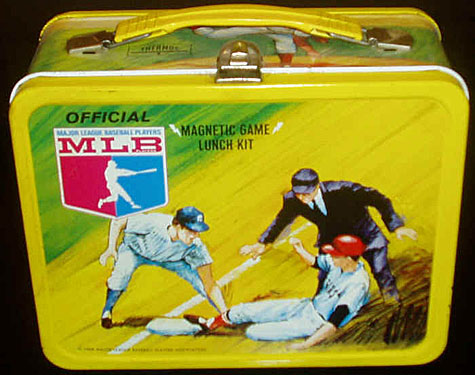
This was one of my favorite lunchboxes when I was a kid. This is probably around 1971, fourth grade. It came with a diamond on the back, magnetic baserunner markers, and a spinner, a la All-Star Baseball. Probably the first baseball simulation I ever played, with friends after a PBJ and two-cent milk in the school cafeteria in Titusville.
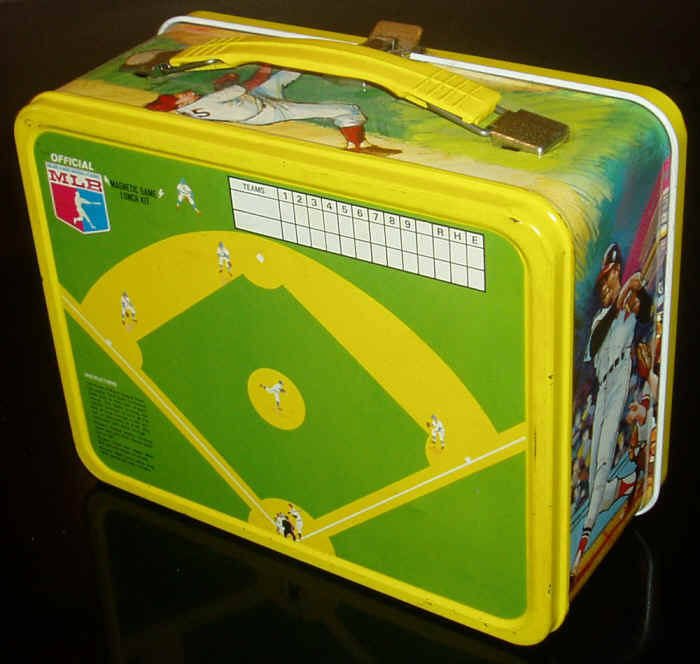
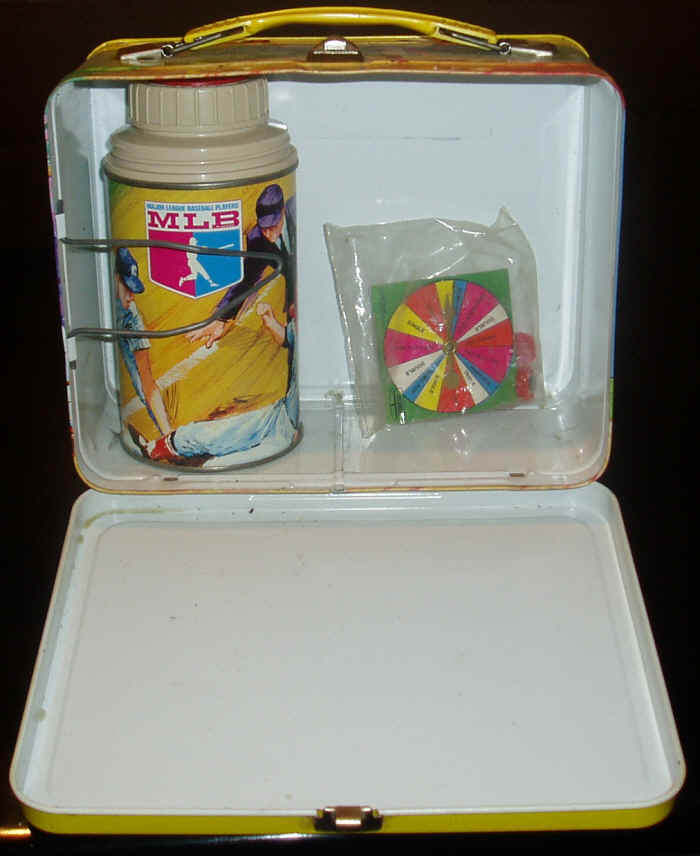
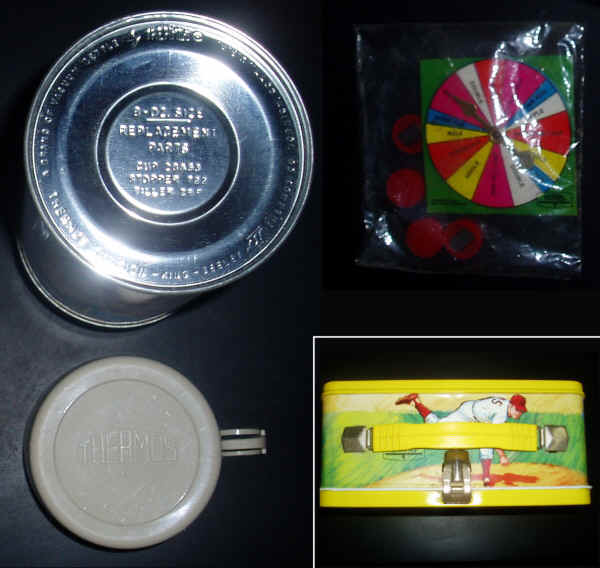
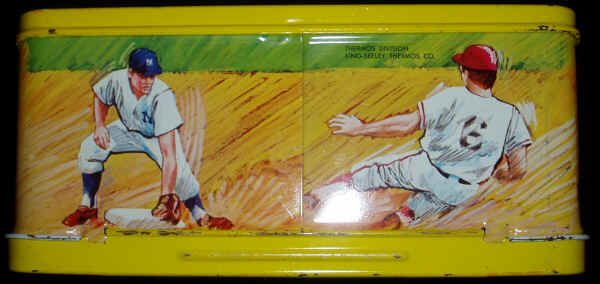
Just noticed that the positioning of the infielders on the diamond is dumb. They’ve got a shift on for a righty, but the batter bats lefty. Must’ve slipped past their fact checkers!
[via]
Baseball Digest
Baseball Digest is now archived at Google! Issues range from 1945 through 2007. Some issues missing from the early years.
Robison Field
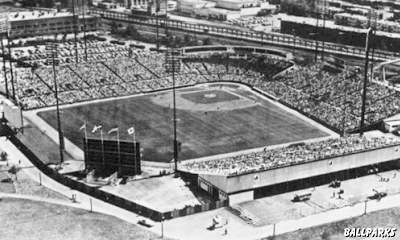
Interesting article about Robison Field, home to the St. Louis Browns/Perfectos/Cardinals from 1893 to 1920. The field had some funky dimensions, as can be seen from the illustration: 470 in left, 500 center, 290 in right.

[image via]
Things I learned:
- The Cardinals were originally named for the color of their stockings, not the bird.
- The first woman owner in major league baseball was Helene Hathaway Robison Britton, who owned the Cardinals from 1912 to 1916.
Batting Order by The Book
The Book‘s batting-order advice:
Your three best hitters should bat somewhere in the #1, #2, and #4 slots. Your fourth- and fifth-best hitters should occupy the #3 and #5 slots. The #1 and #2 slots will have players with more walks than those in the #4 and #5 slots. From slot #6 through #9, put the players in descending order of quality.
The Book admits a slight advantage in batting the pitcher eighth.
New Triple Play Cards
The new Triple Play Baseball cards arrived in upstate New York today.

Searchable TSN on line
Via Fungoes, a tip about Paper of Record, a site that archives newspapers, including The Sporting News. Registration is required, but free.
Wrigley Field, May 16, 1977
Here’s a short clip from Wrigley Field. Super 8 to VHS to digital camera, thus crummy quality. Cubs starter Donnie Moore warms up. In the fourth, Larry Biittner singles to center, scoring Ivan DeJesus. Manny Trillo flies out to shallow right in the sixth. Final 9-6. Cubs win!
Parc Jarry
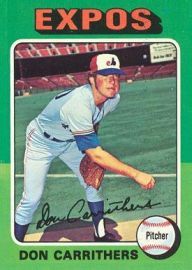
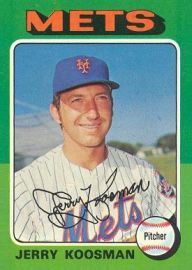
An old document from the archives revealed the date of the game I saw at Jarry Park in 1976, the Expos hosting the Mets. Tied at one going into the bottom of the ninth, Ellis Valentine led off with a double. After Bombo Rivera grounded out, moving Valentine to third, the Mets intentionally walked Larry Parrish and Jose Morales to load the bases. Mets starter Jerry Koosman was still hurling, and he faced Andre Thornton, looking for the DP to send the game into extra innings. Thornton stroked one to center for the win.
Signs of how long ago this was: both starting pitchers went the distance, the attendance was 13,102 on a Sunday afternoon, and the game was completed in 2:07.
APBA: back to basics
I started out with APBA back in ’74, but have played only a handful of games in the last 25 years. I’ve been trying out a few different TTBB games over the last year, and the other week I started thinking about APBA again. After losing an eBay auction for an 80s edition, I ordered a new copy, curious about how the charts & cards have changed since the old days.
What’s in Manny’s mouth?
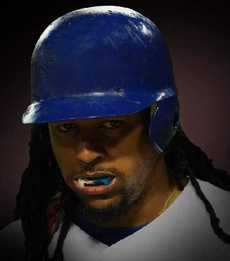 Ramirez is having a great post-season (even though his Dodgers are close to going down at this moment), but what’s that funky colored thing in his mouth? Looks like a mouthpiece, but why would a baseball player need a mouthpiece? Turns out it’s a “Pure Power Mouthpiece,” which claims to improve athletic performance. Riiiight. Cost? $2000. Fitted by “certified” dentists, not just boiled up in a pot like we did back in the day. It’s a Breathe Right for your mouth!
Tilt-shift Stadia
Here are a couple of tilt-shift fakes I made in Photoshop. Click to enlarge.
Lil Yankee Stadium:

Lil Shea:

Perfectos hitting: lousy batters or lousy dice?
As the regular season progressed, it seemed clear that several of the Titusville batters were underperforming. Rollins, Blalock, & Howard were all hovering around the Mendoza line. Run production was near the bottom of the league. What was going on?
With the end of the regular season, I can analyze this using the Legend’s excellent stats. I looked at the performance of my regulars compared to their 2007 MLB performance. (2007 MLB = 2008 ABL) I’ll assume that TPB is accurate in reproducing replay stats. I’ll select OPS (On-Base plus Slugging) as my metric, and I’ll include batters with more than about 90 ABs.
The Perfectos regulars lagged an average of 131 points below their MLB levels. Ouch! (Complete numbers are after the jump.) Rollins, Blalock, & Howard were all 200 points below. Ludwick & Castro weren’t much better. Only Pat Burrell managed to beat his MLB number.
OK, it’s not surprising that the ABL numbers are lower, since the batters are facing the cream of MLB pitching in the ABL. Is Titusville’s lag seen on other ABL squads? I ran the numbers for a few teams, some good, some not so good. No one comes close to Titusville’s underperformance. They range from -67 for St. Augustine to -38 for Tallahassee.
I looked for patterns, like sluggers doing worse than singles hitters, but I didn’t see anything.
Could the Perfectos from the Phillies be hurting because they play in a small MLB park? Doesn’t seem so. Howard did awful in the ABL, but Burrell did good.
So, maybe I’m wrong, but it sure seems like the Titusville batters got lousy rolls during the 2008 ABL season.
Continue reading Perfectos hitting: lousy batters or lousy dice?
Hand of pitchers facing Titusville
I counted the IPs of LH/RH pitchers that faced the Perfectos during the ’08 regular season. Lefties started only two of the 36 games, 5.6%. Lefties appeared in 30.6% of the games. Lefties accounted for only 9.29% of the innings pitched. Wow, that’s low.
Now, when I looked at this before, I determined that 21.7% of IPs were from lefties from the ’07 ABL stats. How did I get that, exactly?
Baseball Research Journal
SABR has put back issues of the Baseball Research Journal on line. The website archives the 1972 thru 1984 editions plus the 1986 and 1989 editions.
Favorite articles:
- A Bizarre Game of Baseball
- Is Pitching 75% of Baseball? Expert Opinions 50 pros say: 60% pitching, 22% hitting, 15% fielding, 4% other. Hmmmm
- The Worst Season Ever The 1899 Cleveland Spiders, victims of the St. Louis Perfectos
- Three Dimensional Baseball The Yankees, Dodgers, and Giants play each other in one game!
- The Batter’s Run Average (B.R.A.) What came first—this or Bill James’ Runs Created?
- Chris Von der Ahe: Baseball’s Pioneering Huckster St. Louis Browns owner
- The 1887 Binghamton Bingos
Pitchers Not Batting Ninth
The countdown search provided an opportunity to identify all the instances of pitchers not batting ninth in the starting lineup. (Standard Retrosheet caveats apply: data runs from 1954-2007, and some games prior to 1974 are missing.)
There are a few periods during which it was used as a consistent strategy.
- Bobby Bragan batted his Pirate pitchers in the 7 spot for the last couple weeks of the 1956 season.
- Lou Boudreau hit the pitcher eighth during the first half of Kansas City’s 1957 season. He was fired soon after.
- Tony La Russa revived the idea in the second half of the 1998 Cardinal campaign.
- TLR took it up again in the last month of 2007. Of course, Tony has been using the pitcher in the 8 slot all season this year. Ned Yost was doing the same thing in Milwaukee, but gave it up in late May.
Some individual pitchers have occasionally batted earlier in the lineup due to their hitting prowess: Don Larsen (.242 career BA), Bob Lemon (.232), and Dontrelle Willis (.234).
The big drought was 1958-1997, during which I find only six occurances.
Cesar Tovar was the only pitcher to lead off the game. Of course, that was his nine-position game in 1968.
Ken Brett batted eighth for the White Sox in front of 3,278 at Comisky late in the 1976 season. That’s the only example I can find of an AL team not using the DH at the start of the game.
The complete list appears after the jump.
Countdown Lineup
I use numeric indicators when writing a lineup: 1 for pitcher, 2 for catcher, 3 for firstbaseman, etc. Looking at a lineup the other day I wondered how often there had been a perfect “countdown” lineup in MLB, that is, rightfielder (9) leading off, followed by centerfielder (8), all the way down to pitcher (1) batting ninth.
It gave me an opportunity to work with the Retrosheet game logs, as oppposed to the event files, which I’ve used before. I was a bit disappointed to find that the lineup data in the game logs is pretty much limited to the years for which there are event files, basically 1954-2007. No biggie.
Well, I found not one single instance of a 987654321 lineup! I found two examples of 987653421, but that was about the closest. Strange that it’s never happened in the last 50-odd years.
The most common lineup in the period is 847395261, which looks about right.